Friday, January 2, 2009

Termites and monkeys

One day, while driving from one location to another on one of the many narrow two-lane roads that run through the countryside of India, I spotted a huge mound of dirt.

Sure enough, it's a termite mound. But, more interesting than that, the mound pictured here is about four to five feet tall, with a larger hole than termites require.

When termites build a home as large as this, another creature sees it as a desirable living space: cobras. In this case, it appears that a cobra has moved in to its new digs.

Furthermore, cobras hold significance to the Indian people. When a termite mound becomes the home of a cobra, the local people start making offerings and prayers to the snake, which is thought to have powers of its own. As time goes on, the mound can even been reinforced, decorated or otherwise modified by the local population, in ongoing honor of its revered occupant. Ultimately it can become a small, local temple of its own.


Meanwhile, down the road from the termite-mound-cum-cobra home, we spotted many monkeys being fed by a local man.

Amazing creatures, monkeys are fascinating to those of us who don't see them in our day-to-day lives, but they do become difficult pests when encouraged to get food from people. Our guide told us of a woman who stayed at a hotel with a local population of monkeys that regularly stole things from the hotel's rooms' balconies. Either she forgot or did not hear the warning and hung some hand-laundry out to dry on her porch. Pretty soon the monkeys were swinging around with her underwear!

Thursday, January 1, 2009

The Third Day of Pongal--Cow's Day

Back to the celebration of the New Year which is called Pongal in India.

The third day of celebration is cows' day. Being a revered animal (and a significant contributor to the health of a family), the family cow has its own special day.


At every local market, several vendors sell many powders of brilliant colors for the various Pongal purposes.

(You've seen them before, used in the designs drawn in front of the homes-- see my March 12, 2008, posting.)


For this third day of celebration, they are used on the cows.

First, the animal is washed thoroughly in a nearby river or lake.

Next, dots of the powdered colors are used to decorate its body; in the picture of the calf here, additional decorative material has been placed around his neck.


Once prepared, the family cow is allowed inside the family's home for a while!


Other animals get to enjoy the special status on this day as well......


For more great information on Pongal, which is celebrated this month (January) each year, please see Varun Withu's blog (link posted on my site here)!

Monday, May 26, 2008


I've been away from the blog for a while now-- so sorry! -- but I have a few pieces to share tonight.

The next day after seeing the fortune teller, we traveled through the countryside. Pretty soon we came to a very small village and pulled to a stop slightly outside of it.

We approached an inauspicious-looking dirt road on foot. Not until we got closer did we see a most beautiful sight of hundreds of folk-art animals lining the road on both sides.

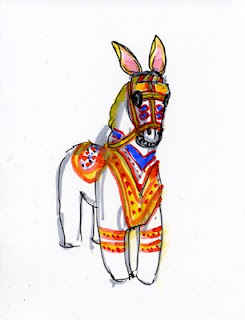
Most of the ceramic sculptures stood between four and six foot in height, I would guess. Horses were primarily represented, with some cows, some elephants and a few other miscellaneous animals. Apparently the horses were created an installed here for good luck in battle (of some kind). They were in various states of repair-- many no longer had paint; some were broken; and other, newer ones were in stellar condition. The paint patterns, expressions, sizes and shapes were greatly varied and entertaining!
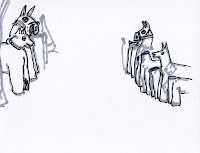
The men (I presume they were men) who made these large ceramic pieces are older now, and the art of them is being lost as the men die. Additionally, the 'need' to petition for blessings on a horse for battle is not as great these days.

At the end of the road, which must have been almost one-half mile long, a huge tree served as the temple to which these offerings had been made. The base of the tree (and moving up the trunk) had hundreds more sculptures, mostly small and many quite naive. These pieces depicted children, animals and all other sorts of things, all in the hopes of having blessings--perhaps for a child to be born, or for an animal that had taken ill.

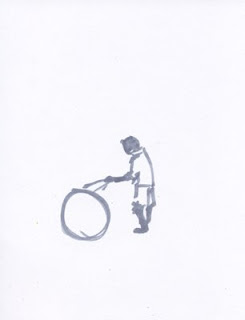
As we left, we saw some children playing with a stick & a tire... one of the oldest games in the world.
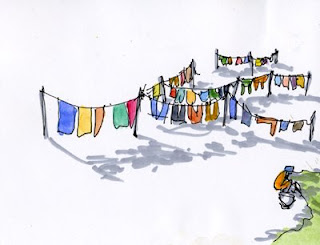
Later, on the road to our next adventure, we passed a river where an enterprising soul was doing quite a bit of laundry-- perhaps for her family, but it looked as if she may have been doing it as a business. Naturally, I could not resist the colors.....


Continuing down the small country roads, we see people taking goods to market...
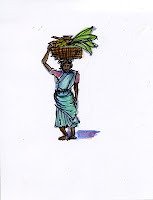

... and our guide tells us that our bus is passing between mango groves on our right and cashew trees on our left. I think I could live in a neighborhood like that!
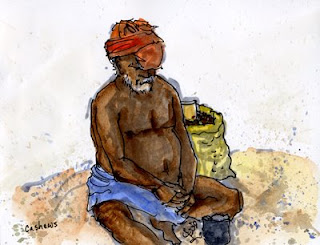


We stopped to see a family who shelled and roasted cashews by the side of the road. This is the father, who is doing the shelling (not an easy task).

Sunday, April 27, 2008

Indian Travels Continue

The musicians' village was situated along a river, of course, and, as usual, we saw several women washing their clothes that morning. Though every village has a water pump like the one you see here in sketch at the right, the pump supplies potable water to small villages like this only once a day for two to three hours in the afternoon. (The sight of children playing in the water was singular-- I never saw it but once, since water is so precious.) Villagers must cart their water back to their homes in containers, being sure to have plenty to last them until the next afternoon.


Thus the washing and bathing must take place in rivers.


We headed back into town to see a large temple complex at sundown--the perfect time for this temple, as the low sun backlit it perfectly.


We also visited a museum and continued our education of the Hindu religion by studying the centuries of art produced to depict the gods and their activities. Outside the museum, I found my first Indian phone booth....


... while, in town, we found a fortune teller. As you can see from the sketch, he had a parrot (and parrots are one of my interests). The parrot is essential to his fortune telling. It resides in or on its cage throughout the day until someone asks for their fortune to be told. At that point, the client shuffles the stack of thick cards. The fortune teller sets the cards out on his blanket. The parrot walks over to the stack of cards and starts to remove one card at a time, setting them aside. Finally, the bird pulls a card which he sets closer to the teller. The teller turns the card over and reads the client's fortune!

Wednesday, March 12, 2008

Signs of Pongal

We are traveling in the month of January, 2008, and we're now deep into the state of Tamil Nadu. Now we start to see signs of Pongal as we go.

Pongal is the celebration of the new year, or, more specifically, happiness that the sun is coming back. Pongal consists of three days (plus or minus): a day of preparation, the day of Pongal itself, and the cows' day.

The woman you see at the right is carrying dry but unbaked Pongal pots. We passed her family as we were on our way to one place from another, and the whole family worked. The father and a kid or two were stoking the fire, while the woman and a girl carried pots she'd made over to be bisqued/fired. There were dozens of these pots, which are used on the day of Pongal; families take a handful of the first rice harvest of the year and boil it in one of these pots until it boils over. More about this later....

We headed off to a small village off the beaten track. This is a musicians' village, and a group of four men and four women who simultaneously play instruments and dance to the music (plus a few other musicians, too) are regularly hired to play for various celebratory occasions everywhere in Tamil Nadu.


The people of this village have rarely been visited by tourists, so far fewer of the children rush up to you, begging: "Pen! Pen!" as in some of the other locations we'd been to. In fact, many of the people in the village don't go to see the celebrations where their musicians & dancers play & dance, so they enjoyed the show, as well.


Another sight one sees during the preparation for Pongal is the decorative patterns many women draw on the ground in front of their homes. The designs are drawn with white chalk-like material; then sections are colored in as the artist likes. Some women draw more than one. As the days go on, the designs wear off under the feet of the people passing, until next year's Pongal season. Below you see some kids in the musicians' village, surrounding a large and more "naive" version of the many, many designs we saw:
After dancing us around the village, the musicians and we took a break for a cup of tea with others for a few minutes. Upon return, to begin dancing again, the musicians had to warm their drums to ready them for playing. They built a small fire off to the side...


....then started to play and dance again.

Saturday, March 1, 2008

Moving on

Next, we drove to Pondicherry, an area that was French for a while, with the colonial qualities that the French loved reflected in the architecture, foods (of course!) and, as you can see from the gendarme at right, some less expected areas....


We visited a church within walking distance of our hotel. Across from the gate, a man slept on the sidewalk. I gathered from another man nearby that both of them regularly spent their days there.


We traveled next to Chidambaram. We got there in time to witness a morning service which, in this case, involved the offerings of what appeared to be a wealthy family (as evidenced by the amount and quality of the offerings poured on the altar). Many priests were present to participate at the ceremony; these are men of the Brahmin class whose lives are devoted to their temple.

Here (to the right, above) I've drawn the main ceremony, but there were several other, smaller scenes at play, too, such as the body language of the priest to the left and the flower offerings for sale, should a visitor wish to participate in the proceedings.

Friday, February 29, 2008

More sights


Getting back to our travels, we went to Mahabalipuram, part of a 7th century dynasty, with massive rocks and rock cliffs. As you can see from the photo at the right, artists spent some serious time carving figures in the stone. I liked the little elephants under the big ones...

so I drew them.


This wall represents only a small fraction of the amazing carvings located here. Whole temples with bas reliefs and pillars and inner rooms were carved out of the huge stone cliffs. As we left, we saw a stone boulder with cruder, unfinished carved figures in no particular pattern; the guide said this was a "practice" stone, perhaps for evaluating a carver's talent.


Here's a photograph of some of the bas reliefs we found inside the temples. Very sophisticated work.


Our first glimpse of monkeys came as we climbed steps here to see a temple carved on top of a hill of stone. Not having drawn monkeys before, I was working out their shape in my mind, as you can see here.


We headed out & over to another complex of unfinished temples. There, the grounds were being weeded by several women, two of whom I drew. As usual, the clothes presented a kaleidescope of pleasure.

This complex included some gigantic stone sculptures of several animals, one of which was the elephant shown below. You can see a couple of tourists taking advantage of his shadow-- the day was quite hot.